

For many adults with ADHD, forgetting a task is not about not caring.
It can be connected to:
• time blindness
• task switching
• stress
• overwhelm
• unclear priorities
• reminders appearing at the wrong time
A reminder that simply says “do this now” may not be enough.
Sometimes, it just creates another stressful interruption.
✦ The best ADHD reminder app is not the loudest app. It is the one that helps you notice what matters without making your day feel heavier.
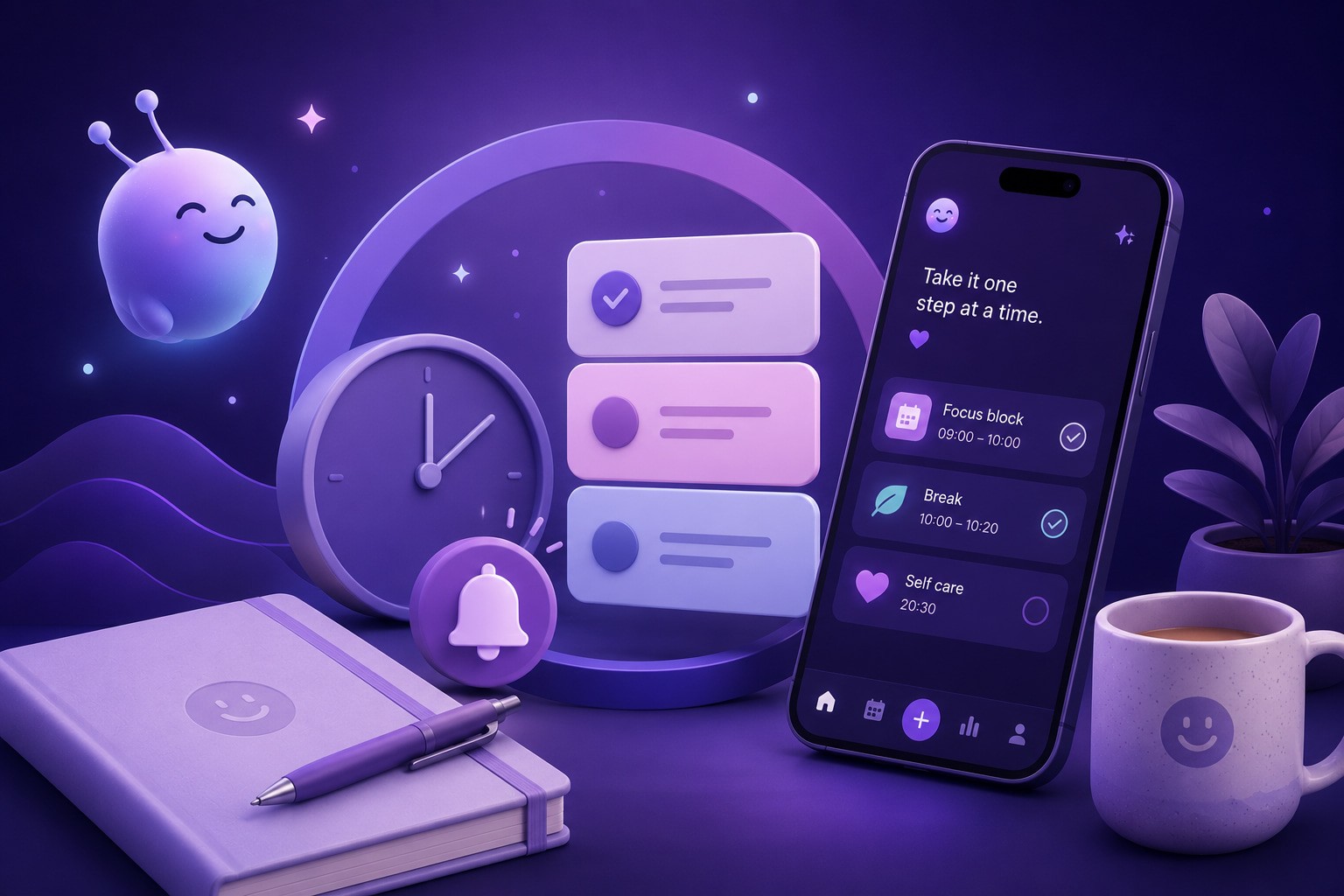
Mindory is designed around this calmer idea. It helps you create reminders inside a realistic plan, so they feel less like random alerts and more like supportive guidance.
Mindory’s purpose is to make life easier and less stressful for people with autism, ADHD and related challenges through stress awareness, productivity tools and friendly AI support. Its brand voice is built around empathy, simplicity and feeling understood without judgment.
What is an ADHD reminder app?
An ADHD reminder app is a planning tool that helps people remember tasks, appointments, routines and transitions in a way that supports executive function.
For ADHD adults, useful reminders often need more context than a basic alarm.
A strong reminder should help answer:
• What do I need to do?
• When should I do it?
• How long might it take?
• What is the first small step?
• Is this the right moment to act?
ADHD can affect attention, organisation and completing longer tasks, and those needs can look different in adulthood, according to the CDC.
That is why reminders should reduce mental effort, not add more.
What is the best reminder app for ADHD?
The best reminder app for ADHD is one that makes reminders timely, visible, specific and connected to a realistic schedule.
That means a helpful reminder is not just:
✗ “Pay bill”
A more supportive reminder is:
✓ “Pay electricity bill after lunch. Card is saved. Takes about 3 minutes.”
The second version is easier to act on because it gives your brain a clearer path.
✦ Effective ADHD reminders are timely, visible, specific and connected to a realistic schedule.
Mindory supports this by helping reminders sit inside your daily structure, instead of floating around as isolated notifications.
Why many reminders feel annoying
Many reminder apps rely on one simple idea:
• more alerts
But more alerts do not always mean more follow-through.
A reminder can feel annoying when it:
✗ interrupts at the wrong time
✗ gives too little information
✗ feels urgent when it is not
✗ appears too often
✗ creates guilt instead of clarity
✗ disappears after being dismissed
✗ reminds you of the task but not how to start
After a while, your brain may begin to tune the reminders out.
This does not mean you are failing.
It may mean the reminder system is not built around how your attention, time awareness and stress actually work.
Why Mindory takes a gentler approach
Mindory focuses on reminders inside a realistic plan.
That matters because many missed tasks are not only memory problems. They are planning problems, transition problems or overwhelm problems.
For example, a standard reminder might say:
• “Dentist at 3:00 PM”
That can help, but it may not be enough.
A more ADHD-friendly reminder flow could look like:
✓ 1:55 PM: Pause current task
✓ 2:05 PM: Check wallet, keys and headphones
✓ 2:10 PM: Put shoes on
✓ 2:20 PM: Leave home
✓ 3:00 PM: Dentist appointment
✦ The appointment was not the only thing to remember. The transition needed support too.
CHADD describes time blindness as difficulty estimating time, sequencing time and judging how much time has passed or remains. It can affect appointments, deadlines, routines and daily tasks.
Mindory helps by making the steps around the reminder easier to see.
What makes a reminder ADHD-friendly?
An ADHD-friendly reminder should reduce cognitive load.
It should not ask you to decode, prioritise and emotionally recover all at once.
✓ It is specific
Vague reminders create more decisions.
Less helpful:
✗ “Admin”
More helpful:
✓ “Send invoice to Alex before 4 PM”
Even better:
✓ “After lunch, send invoice to Alex. Template is in email drafts.”
✓ It appears when action is possible
A reminder that appears while you are driving, in a meeting or already overwhelmed may only create stress.
Better timing looks like:
• “Pack laptop” before leaving, not after arriving
• “Start dinner” before you are extremely hungry
• “Send form” during an admin block
• “Take laundry out” when you are already near the kitchen
✦ A good reminder meets you where your day actually is.
✓ It includes the first step
Task initiation can be hard when the task feels too big.
Instead of:
✗ “Clean kitchen”
Try:
✓ “Put plates in dishwasher for 5 minutes”
Instead of:
✗ “Taxes”
Try:
✓ “Open tax folder and find last payslip”
The task may still take effort, but the starting point is clearer.
✓ It respects stress and energy
Some days have less capacity than others.
A helpful reminder system should not assume every day is a high-energy day.
Mindory’s broader approach includes understanding stress factors, offering productivity tools and giving personalised support that feels practical and compassionate.
That is important because reminders are easier to follow when they match the day you are actually having.
Reminder examples for ADHD adults
Here are examples of reminders that feel clearer, kinder and easier to act on.
Appointment reminders
Less helpful:
✗ “Doctor 4 PM”
More helpful:
✓ “Doctor at 4 PM. Leave at 3:20 PM. Bring ID, headphones and water.”
Why it helps:
• includes leaving time
• reduces last-minute searching
• supports the transition
• makes the appointment feel less vague
Work task reminders
Less helpful:
✗ “Finish report”
More helpful:
✓ “Open report and write the first 3 bullet points. Stop after 15 minutes if needed.”
Why it helps:
• lowers pressure
• gives a clear first step
• makes progress feel possible
• avoids all-or-nothing thinking
Household reminders
Less helpful:
✗ “Clean flat”
More helpful:
✓ “Reset desk: throw rubbish away, move cups to kitchen, put notebook back.”
Why it helps:
• defines what “done” means
• avoids an overwhelming task label
• gives a short, visible action
Social reminders
Less helpful:
✗ “Message Sam”
More helpful:
✓ “Reply to Sam: ‘Friday works for me. What time?’”
Why it helps:
• removes the hidden writing task
• makes the response easier to start
• reduces decision fatigue
Routine reminders
Less helpful:
✗ “Morning routine”
More helpful:
✓ “After brushing teeth, check today’s plan in Mindory.”
Why it helps:
• links to an existing habit
• makes the next step simple
• supports daily structure
Break reminders
Less helpful:
✗ “Take break”
More helpful:
✓ “Stand up, drink water and look away from the screen for 2 minutes.”
Why it helps:
• makes the break concrete
• avoids turning rest into another vague task
• supports stress-aware planning
Common reminder pitfalls to avoid
Even a helpful reminder app can feel frustrating if the setup is too heavy.
Here are common pitfalls.
✗ Setting reminders for everything
When every small task becomes an alert, reminders can turn into background noise.
Try using stronger reminders for:
• appointments
• bills
• medication routines
• work deadlines
• leaving the house
• important messages
• tasks that create stress when missed
✗ Writing reminders your future self will not understand
A reminder like “sort that thing” may make sense when you create it.
Three hours later, it may mean nothing.
Write reminders for your future self with care.
Try:
✓ “Put signed school form in backpack”
Instead of:
✗ “School thing”
✗ Forgetting transition time
Many missed appointments happen because the preparation was not planned.
For example:
• stopping the current task
• finding keys
• changing clothes
• packing a bag
• leaving the house
• travel time
• parking or walking in
✦ If the transition is invisible, the reminder may arrive too late.
✗ Making the reminder too big
“Clean the whole apartment” can feel impossible.
“Clear the sink for 5 minutes” is more approachable.
A good reminder helps you begin.
It does not need to contain the whole task.
✗ Using reminders as self-criticism
Avoid reminders like:
✗ “Do not mess this up again”
✗ “You forgot last time”
✗ “Stop being lazy”
Try:
✓ “Pause and send the form now. It should take about 5 minutes.”
✓ “Start with the first step only.”
✓ “You do not need to finish everything. Just open the task.”
✦ A reminder should feel like support from a helpful friend, not pressure from a disappointed manager.
How to create better reminders in Mindory
Mindory works best when reminders are connected to your real day.
Here is a simple way to build them.
1. Choose what truly needs a reminder
Start with the tasks that often become stressful when missed.
For example:
• appointments
• deadlines
• medication routines
• paying bills
• meal breaks
• leaving the house
• replying to important messages
• switching from one activity to another
2. Put the task into your day
A task without time can become invisible.
Instead of leaving it as:
✗ “Call pharmacy”
Place it somewhere realistic:
✓ “Call pharmacy after lunch, before opening email again.”
3. Add transition reminders
For time-sensitive tasks, add reminders before the event.
Example:
✓ “Finish current task”
✓ “Gather what you need”
✓ “Leave now”
✓ “Appointment starts”
This can be especially helpful for time blindness.
4. Make the reminder concrete
A useful reminder should be easy to understand quickly.
Use:
• a clear verb
• a realistic time
• a small first step
• helpful context
• kind wording
Example:
✓ “Open banking app and pay electricity bill. Takes about 3 minutes.”
5. Notice what you dismiss
If you keep ignoring the same reminder, the task may need a better setup.
Ask:
• Was the timing wrong?
• Was the task too vague?
• Was I already overloaded?
• Did I need a smaller first step?
• Did the reminder appear too often?
This is not about blame.
It is about adjusting the system.
Why Mindory is a strong ADHD reminder app
Mindory is a strong fit for adults who need more than basic notifications.
It may help if you:
✓ miss tasks even when you care about them
✓ forget appointments despite calendar alerts
✓ feel stressed by constant notifications
✓ struggle with time blindness
✓ need support with transitions
✓ want reminders connected to a realistic plan
✓ prefer gentle planning over pressure
✓ need help turning tasks into smaller steps
Mindory is built as a supportive companion for people with ADHD, autism, stress, time management challenges and focus difficulties. Its brand values include empathy, inclusivity, empowerment, wellbeing, simplicity and diversity.
That makes Mindory especially relevant for reminders that need to feel calm, practical and human.
Best ADHD reminder app for people who miss tasks or appointments
The best ADHD reminder app is not the app that sends the most notifications.
It is the app that helps you act on the right reminder at the right time.
Mindory supports this by helping you:
• plan your day realistically
• create reminders with context
• break tasks into smaller steps
• prepare for transitions
• reduce overwhelm around missed tasks
• return to structure when attention shifts
✦ Mindory turns reminders from isolated alerts into part of a calmer daily support system.
Create reminders inside a realistic plan with Mindory
If reminders usually feel annoying, Mindory offers a gentler way to use them.
As an AI planner and ADHD planner app, Mindory helps connect reminders to the shape of your real day, including appointments, transitions, routines and task steps.
Instead of pushing you with more noise, Mindory helps you build reminders that feel clearer, kinder and easier to follow.
Create reminders inside a realistic plan with Mindory, and give your future self support that feels practical, calm and human.
FAQ
What is the best reminder app for ADHD?
The best reminder app for ADHD is one that makes reminders timely, visible, specific and connected to a realistic schedule. Mindory supports this by placing reminders inside a calmer daily plan.
Why do ADHD reminders stop working?
ADHD reminders often stop working when they are too vague, too frequent, badly timed or disconnected from the next step. A better reminder gives context, timing and a small action.
Are reminders helpful for ADHD adults?
Yes, reminders can be helpful when they support planning, organisation and task initiation. ADHD in adults can involve difficulty with attention, staying organised and completing tasks, according to the CDC.
How can I make reminders less annoying?
Use fewer but clearer reminders. Make each reminder specific, timed realistically and connected to a first step. Avoid reminders that sound critical or urgent when they are not.
Should I use reminders or a calendar for ADHD?
Many people benefit from both. A calendar shows what is happening, while reminders help you act at the right moment. Mindory helps connect reminders to a realistic daily schedule.
Can Mindory help with time blindness?
Mindory can support time blindness by helping users plan transitions, add preparation reminders and break tasks into visible steps. It is not a medical treatment, but it can support daily structure.
—
Mindory App was created together with the licensed psychotherapist Alain Massen. It is a gentle AI planner app designed for people with ADHD and autism.
The app helps users anticipate stress, break larger tasks into manageable steps, and stay organised through integrations with Google Calendar, Apple Calendar, and health apps.
Mindory is also used as an add-on for our neurodiversity training programmes.