

Finding the best ADHD schedule app can feel strangely stressful.
You may already have a calendar. You may already have a to-do list. You may already have reminders, notes, alarms and screenshots of things you meant to remember later.
And still, the day can feel slippery.
That does not mean you are lazy, careless or “bad at planning.” For many ADHD adults, the challenge is not knowing that tasks exist. It is turning those tasks into a realistic day, remembering them at the right time, starting when the task feels too big and recovering when the plan changes.
That is the kind of planning support Mindory is built around.
Mindory is a personal stress and productivity companion designed with ADHD and autism in mind. It helps people manage their day, energy and stress with tools such as daily planning, an AI companion called Mindy, focus support, wellbeing tools and a personal stress fingerprint that learns individual stress patterns over time.
The best ADHD schedule app is not the one with the most features. It is the one that helps you stay on track in real life.
What is an ADHD schedule app?
An ADHD schedule app is a planning tool that helps with daily structure, time awareness, reminders, routines, task capture and staying on track.
A basic calendar can show appointments. A to-do list can store tasks. But an ADHD daily scheduler should help with the space between those two things: what needs to happen, when it can realistically happen and how to restart when the plan changes.
For ADHD adults, planning often involves more than writing things down. It can also involve estimating time, switching tasks, noticing energy, managing overwhelm and remembering what matters at the right moment.
That is why the right app should reduce the invisible work around planning.
It should help you see the day, choose the next step and adjust without shame.
Which schedule app is best for ADHD?
The best ADHD schedule app depends on your needs, but Mindory is designed around many of the features ADHD adults often look for: realistic scheduling, visual daily structure, reminders, voice or text task capture, flexible rescheduling, focus support and stress-aware planning.
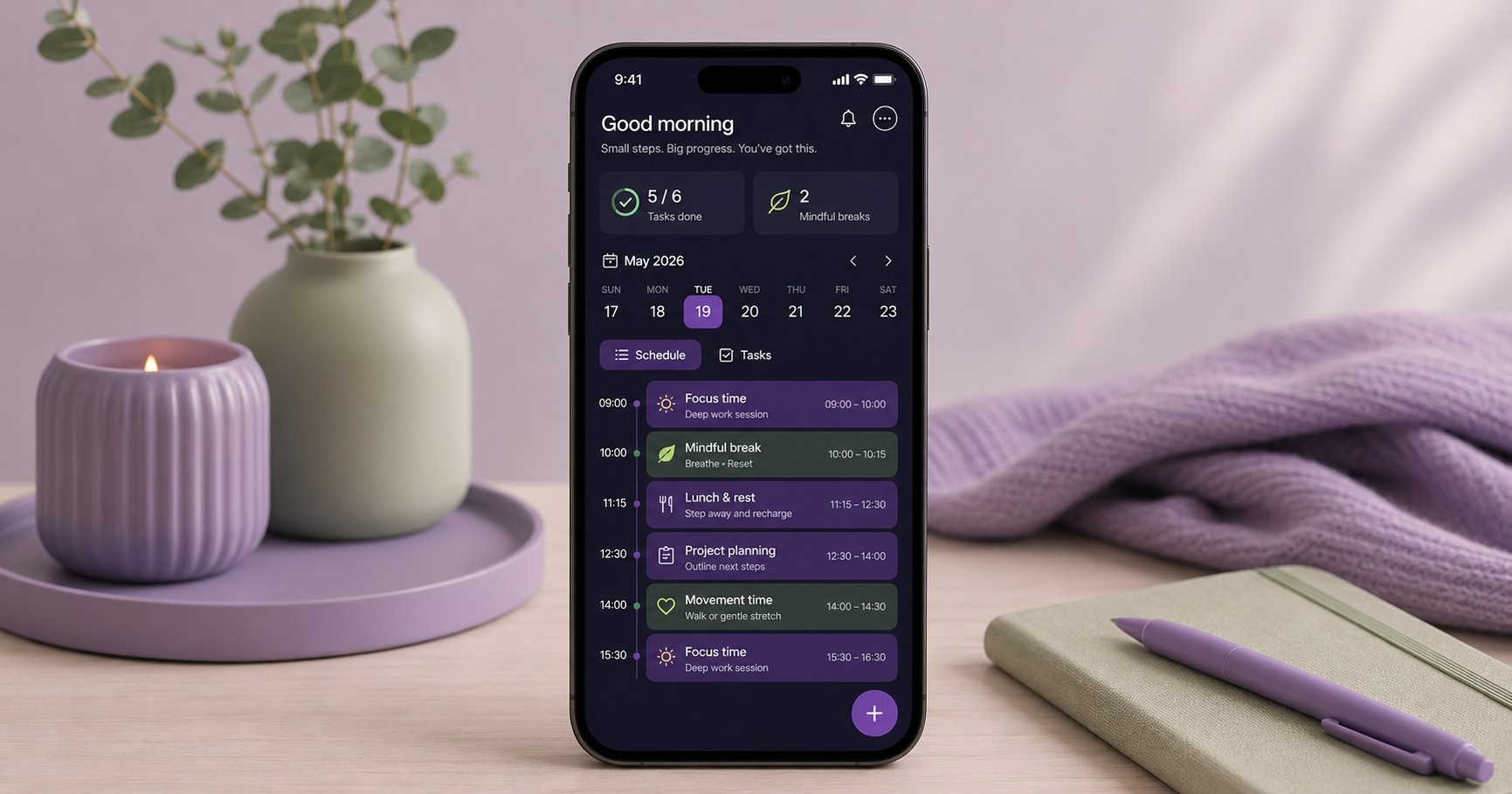
Mindory gives users both a timeline view and a simple Morning, Afternoon and Evening block view, so people can plan in the way that feels most natural to them. It also supports calendar integration, voice input and easy rescheduling.
That matters because ADHD planning is rarely just about making a list.
It is about reducing the hidden effort around the list.
Mindory helps by supporting the steps that often get missed:
✓ Turning tasks into a realistic day
✓ Helping you see what fits
✓ Capturing tasks by voice or text
✓ Supporting reminders and follow-through
✓ Making it easier to adjust when plans change
✓ Offering focus and wellbeing tools for real moments of overwhelm
✓ Providing a calmer, companion-like planning experience
Mindory does not need to be the universal best choice for every ADHD adult. A person who only wants a simple place for appointments may prefer a basic calendar. Someone managing a large team project may need a project-management platform.
But for ADHD adults who feel stuck between messy to-do lists, time blindness, task initiation struggles and overloaded days, Mindory is built to offer the kind of support a standard calendar often cannot.
Why regular schedule apps often do not feel like enough
A lot of planning tools assume that once you write something down, the hard part is finished.
But if you have ADHD, executive-function challenges or stress-related overwhelm, that may not be true.
• You may write the list and still not know where to start.
• You may put something in your calendar and still underestimate how long it will take.
• You may set a reminder and still feel unable to switch tasks when it appears.
• You may make a careful plan in the morning and feel completely lost by lunchtime.
This is not a lack of care.
It is often a sign that the planning tool is not supporting enough of the process.
Mindory’s own coach guide describes the app as being designed for neurodivergent users with “low friction, high clarity, no shame.” It also describes Mindory as a companion, not a critic: missed tasks are met with rescheduling support, not punishment.
That difference matters.
Mindory is not only there for the perfect planning session. It is there for the messy middle: the scattered list, the unclear next step, the overfull day, the forgotten task and the moment when you need a gentle way back.
9 features that make an ADHD schedule app feel easier to use
The best ADHD schedule app should not feel like another system you have to maintain perfectly.
It should feel like support.
It should help you when your to-do list is too full, when time feels unclear, when you forget what you meant to do next, or when your day changes and you need to adjust without starting over.
That is why Mindory is built around features that support real ADHD planning, not ideal planning.
1. Realistic scheduling when your to-do list is too much
A long to-do list can look simple from the outside.
But inside your head, it may feel like everything is equally urgent, equally heavy and equally impossible to place.
You might look at ten tasks and think, “I should be able to do all of this today.” Then the day starts. One task takes longer than expected. A message interrupts you. You forget lunch. A meeting drains more energy than you planned for. By late afternoon, the list is still there and now it feels personal.
Mindory helps by turning tasks into a more realistic daily plan.
Instead of leaving you with a list and hoping you can figure out the timing, Mindory’s planning tools help shape your day around what can actually fit. Users can plan in a timeline view or a block view, with calendar events acting as fixed anchors and tasks filling in around them.
A helpful ADHD schedule app should make the day feel more possible, not more packed.
Mindory’s value is not in pushing you to do more. It is in helping you create a plan that has a better chance of matching your real time, energy and commitments.
2. A visual day view when time feels slippery
Sometimes the problem is not that you forgot the task.
It is that the day itself feels blurry.
You may know you have a meeting at 13:00, an errand to run, a message to answer and laundry somewhere in the background. But those things may not feel connected in time. They float around as separate demands, each one asking for attention.
A visual day view helps make the shape of the day easier to understand.
Mindory supports this in two ways: a timeline view for people who like to think in hours, and a block view for people who prefer Morning, Afternoon and Evening. The coach guide explains that both views are available so users are not forced into one planning style.
That flexibility matters.
Some days, precise time blocks help. Other days, “morning,” “afternoon” and “evening” may feel more realistic.
A good ADHD calendar app should support both kinds of days.
3. Gentle reminders when starting is hard
Reminders should not feel like being told off.
For many ADHD adults, reminders are not only about memory. They are about transitions: moving from one task to another, leaving the house, starting something you were avoiding, or coming back to something unfinished.
A harsh reminder can create pressure. Too many reminders can become background noise. A reminder that arrives with no context can still leave you thinking, “Okay, but how do I start?”
Mindory’s AI companion, Mindy, is designed to check in, summarize the day, create tasks from voice or text and suggest breaks when someone has been working for too long or when stress may be rising.
The goal is not:
“Why haven’t you done this yet?”
The goal is:
“Here is the next step when you are ready.”
That difference matters.
A supportive ADHD daily scheduler should help you reconnect with your plan without adding shame. It should understand that forgetting, delaying or getting pulled away does not mean you do not care.
It means you need support that meets you where you are.
4. Flexible rescheduling when the day changes
A plan that only works when everything goes perfectly is not very helpful.
ADHD days are often interrupted by energy shifts, forgotten tasks, longer-than-expected errands, meetings, stress, distractions or ordinary life. A task you planned for 20 minutes may take an hour. A focus block may disappear. A morning appointment may leave you more drained than expected.
When that happens, some apps make the day feel broken.
Mindory is designed to make rescheduling painless. Users can move tasks by an hour, two hours or to the next day. At the end of the day, leftover tasks are handled without guilt, so unfinished work becomes something to review and reschedule rather than a reason to spiral.
This is one of the most important features in an ADHD schedule app.
Because staying on track is not only about sticking to the original plan. Sometimes staying on track means adapting the plan and continuing gently.
A good ADHD daily scheduler should help you ask:
• What still matters today?
• What can move?
• What can become smaller?
• What needs to wait?
• What is the next kind step?
Mindory helps support that shift from “I failed the plan” to “the plan can change.”
5. Quick task capture before the thought disappears
You know that moment when a task appears in your brain for three seconds?
✦ Book the appointment.
✦ Reply to that message.
✦ Buy the thing.
✦ Send the form.
✦ Cancel the subscription.
✦ Ask about the meeting.
✦ Move the laundry.
And then it vanishes.
Low-friction task capture helps you catch those thoughts before they disappear.
Mindory lets users add tasks manually, by voice or by telling Mindy what needs doing. Mindy can create tasks from plain language and show a preview before confirming, which removes friction for people who struggle with admin and task initiation.
A good ADHD schedule app should not ask you to choose a perfect category, label, date, duration and priority just to remember one thing.
First, capture it.
Then, when you are ready, Mindory can help you turn that captured task into part of your schedule.
This can reduce the mental load of carrying small unfinished thoughts around all day.
6. Task breakdown when the task feels too big
Some tasks look small in writing but feel huge in your body.
✦ Clean the kitchen.
✦ Sort finances.
✦ Plan the week.
✦ Reply to emails.
✦ Prepare presentation.
✦ Organize paperwork.
A basic app may store the task exactly as you wrote it. But that may not be enough if the task feels vague, heavy or emotionally loaded.
A helpful ADHD schedule app should help break big tasks into smaller, more doable steps.
Mindory supports AI-generated subtasks, which can help users who struggle to break large tasks down.
Instead of staring at “clean kitchen,” your plan might begin with:
● Clear the counter for 10 minutes.
● Put dishes near the sink.
● Take one bag of rubbish out.
● Stop and check what is next.
Instead of “reply to emails,” the first step might be:
✓ Open inbox.
✓ Find the three most time-sensitive messages.
✓ Reply to one.
✓ Take a short break.
✓ Choose the next one.
The goal is not to make every task tiny forever.
It is to make starting less overwhelming.
7. Focus support when attention keeps shifting
Following a schedule is not only about knowing what to do.
It is also about staying with the task long enough to make progress.
That can be hard when your attention keeps shifting, when the task is boring, when you are already tired, or when another idea suddenly feels more urgent. You may want to focus and still find yourself pulled away.
Mindory includes a focus timer with customizable work and rest cycles. Users can choose focus duration, rest periods, number of cycles and longer breaks, then pause and resume when needed.
A supportive ADHD schedule app should not expect constant focus.
It should help you gently return.
That might mean helping you work in shorter blocks, remember breaks, reduce overwhelm or reconnect with the task after getting distracted.
The point is not to force your brain into perfect attention.
The point is to make returning easier.
8. Stress-aware planning when the day feels like too much
Some productivity tools treat stress like an inconvenience.
Mindory treats it as part of the planning picture.
The app’s core feature is a personal Stress Fingerprint. Over time, Mindory learns each user’s individual stress patterns using signals such as phone and wearable data, daily context and behavioral signals. After a learning period, it can show a real-time stress dial and highlight personal factors that may be contributing to stress.
This is important because a schedule is not only about time.
It is also about energy, overload and capacity.
If your day is overloaded, your app should help you notice that. If your schedule is too full, it should support adjustment. If you are already stretched, it should not push you harder just because there is technically space in the calendar.
The uploaded Mindory poster document also emphasizes that neurodivergent people often face extra pressure when environments are not built for them. For example, page 3 highlights masking at work as exhausting and energy-draining, while page 5 focuses on burnout among neurodivergent employees.
That message fits the product clearly.
Sometimes the most helpful schedule is not the fullest one.
It is the one you can actually live inside.
9. Wellbeing tools for the moments when planning is not enough
Sometimes you do not need another task reminder.
You need a way to pause.
Mindory includes wellbeing tools such as guided meditations, breathing exercises and grounding techniques. These are designed for real moments during the day when someone needs to step back, regulate and return more gently.
This matters because planning and wellbeing are connected.
If you are overwhelmed, even a simple task can feel too big. If your body is tense, switching tasks may feel harder. If your day has been noisy, rushed or socially demanding, a schedule alone may not be enough.
A good ADHD schedule app should understand that.
Mindory’s wider approach is not just “manage tasks.” It is “support the person doing the tasks.”
That is a much kinder place to start.
What Mindory helps with
Mindory may be a good fit if you want help with the part of planning that happens after writing the list.
It can support you when you need to:
✓ Turn tasks into a realistic daily schedule
✓ See what fits into your day
✓ Choose between timeline planning and block planning
✓ Remember tasks at the right time
✓ Add tasks by voice or text
✓ Adjust when the plan changes
✓ Break big tasks into smaller steps
✓ Use focus sessions with rest periods
✓ Notice stress patterns over time
✓ Use grounding and wellbeing tools when the day feels too much
✓ Build routines that feel easier to return to
You do not need to have a perfect system before using Mindory.
Mindory is there for the messy middle: the scattered list, the unclear next step, the overfull day, the forgotten task and the moment when you need a gentle way back.
Mindory is there when planning feels harder than it looks
A lot of people see scheduling as a simple skill.
You make a list.
You put things in a calendar.
You do them.
But if you have ADHD, autism, executive-function challenges, stress or overwhelm, it often does not feel that simple.
You may know exactly what needs to be done and still feel unable to start. You may plan the day carefully and still lose track of time. You may set reminders and still ignore them because they arrive when your brain is somewhere else. You may fall behind once and feel like the whole plan is ruined.
Mindory is built for those moments.
It helps you create structure without asking you to become a different person. It supports your day with realistic scheduling, reminders, task capture, flexible rescheduling, focus support and stress-aware planning.
Mindory does not make the promise that every day will go perfectly.
It gives you a calmer way to come back.
How to know if Mindory is the right ADHD schedule app for you
Mindory may be a strong fit if your current system technically works, but still leaves you doing too much of the planning in your head.
Maybe your calendar stores appointments, but not the tasks that need to happen around them.
Maybe your to-do list captures everything, but does not tell you what fits today.
Maybe reminders help sometimes, but they do not help you restart after the day has changed.
Maybe you do not need more motivation. You need a gentler structure that lowers the number of decisions between “I need to do this” and “I am starting.”
Mindory is especially relevant if you often think:
✦ I do not know where to start.
✦ I made a plan, but now I am already behind.
✦ I forgot something important again.
✦ I have too many things in my head.
✦ I need help turning this list into an actual day.
✦ I want structure, but I do not want to feel controlled by it.
✦ I need planning support that understands stress and overwhelm.
A basic calendar can be enough for some people. A simple notes app can be enough for others.
But if you are comparing ADHD schedule apps because your current tools are not helping you stay on track, Mindory is built for that deeper layer of support.
A gentle example: from scattered list to realistic schedule
Imagine your list says:
● Reply to emails
● Prepare slides
● Pick up prescription
● Laundry
● Call landlord
● Pay invoice
● Meeting at 13:00
● Cook dinner
● Text friend back
A basic to-do list stores the tasks. A basic calendar stores the meeting.
But you still have to figure out what fits, what matters first and what to do when one thing takes longer than expected.
Mindory helps turn that scattered list into a more realistic day.
The plan might become:
✓ Start with the time-sensitive emails.
✓ Prepare only the first version of the slides before lunch.
✓ Keep the 13:00 meeting protected.
✓ Move the prescription pickup after the meeting.
✓ Place laundry later, not during the focus block.
✓ Keep dinner simple.
✓ Move anything non-urgent if the day gets full.
✓ Use a short focus timer if starting feels difficult.
✓ Take a grounding break if stress starts building.
This is not about creating a perfect schedule.
It is about giving your day a shape.
When your day has a shape, the next step is easier to find.
Why “best” should mean best for your needs
When people search for the best ADHD schedule app, it is understandable to want one clear answer.
But ADHD support is personal.
Some people need stronger reminders. Some need help seeing time. Some need routines. Some need task breakdown. Some need calendar sync. Some need stress-aware planning because their biggest challenge is not motivation, but overload.
That is why the best choice is not always the app with the longest feature list.
The best choice is the app that helps you feel less alone with the hardest part of your day.
For many ADHD adults, that hard part is not writing the list.
It is staying with the plan after the list exists.
That is where Mindory’s AI planning, timeline and block views, flexible rescheduling, reminders, focus timer, wellbeing tools and Stress Fingerprint can help.
See how Mindory turns your to-do list into a realistic schedule
The best ADHD schedule app is not the one that makes you feel more behind.
It is the one that helps you see your day, choose a next step and adjust when things change.
Mindory is an AI planner and ADHD schedule app created to support people who need daily structure that feels realistic, flexible and kind. It helps turn your to-do list into a schedule you can actually move through, with reminders, focus support, wellbeing tools and stress-aware planning that understands real life does not always follow the plan.
See how Mindory turns your to-do list into a realistic schedule.
FAQ
What is the best ADHD schedule app?
The best ADHD schedule app is the one that helps you turn tasks into a realistic day, remember what matters, adjust when plans change and restart without shame. Mindory is designed around these needs, with AI planning, reminders, flexible scheduling, focus support and stress-aware tools.
Is Mindory an ADHD schedule app?
Yes. Mindory is a personal stress and productivity companion designed with ADHD and autism in mind. It includes daily planning, task capture, reminders, focus tools, wellbeing support, Mindy the AI companion and a personal Stress Fingerprint.
Is a calendar app enough for ADHD?
A calendar app may be enough if you mainly need to remember appointments. But many ADHD adults need extra support with flexible tasks, time awareness, task breakdown, reminders, transitions and rescheduling. That is where an ADHD daily scheduler like Mindory can be more helpful.
What features should an ADHD daily scheduler include?
An ADHD daily scheduler should include realistic scheduling, visual daily planning, reminders, quick task capture, flexible rescheduling, calendar integration, task breakdown and focus support. Mindory also adds stress-aware planning and wellbeing tools.
Can Mindory help when plans change?
Mindory is designed for flexible rescheduling. Users can move tasks by an hour, two hours or to the next day, and the end-of-day experience helps handle leftover tasks without guilt.
—
Mindory App was created together with the licensed psychotherapist Alain Massen. It is a gentle AI planner app designed for people with ADHD and autism.
The app helps users anticipate stress, break larger tasks into manageable steps, and stay organised through integrations with Google Calendar, Apple Calendar, and health apps.
Mindory is also used as an add-on for our neurodiversity training programmes.